
Super Mario 64 speedrun is a timed race through Nintendo’s 1996 platformer, and this guide covers its main categories, the current record picture, which category suits a beginner and how to set up a first attempt. Runners play on original Nintendo 64 hardware or approved emulators, submit to Speedrun.com and compete in five core categories. Below you will find what each one asks of a player and how to pick the right starting point.
Key Takeaways
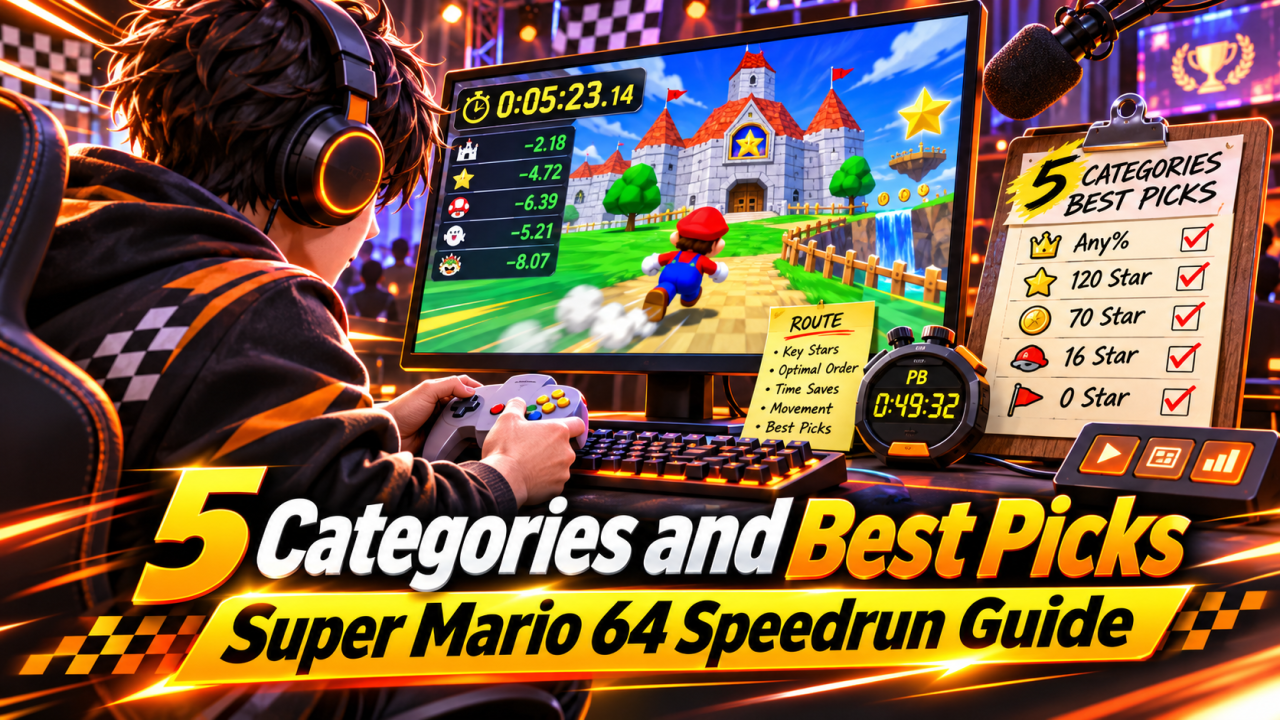
- There are five main categories, named after the stars collected: 0, 1, 16, 70 and 120 Star.
- Suigi became the first runner to hold all five top times at once in November 2024, according to Speedrun.com.
- Every Super Mario 64 speedrun on emulator is ranked apart from console runs, because the game runs at different speeds on each platform.
- Shorter categories teach movement fast, while 70 and 120 Star reward patience and full-game routing.
Why Super Mario 64 speedrun Still Leads the Scene
Thirty years after launch, Mario’s first 3D outing remains one of the busiest boards on Speedrun.com. A 2023 Dexerto ranking built from that site’s data placed it second among all games by total runs, with 40,467 submissions at the time, behind only Subway Surfers.
Part of the appeal is depth. The castle hub, 15 main courses and three Bowser stages give routers endless room to experiment, and new tricks still appear decades later. Another part is spectacle, since top runs move so fast that casual viewers often struggle to follow what just happened.
Types of Super Mario 64 Speedrun Categories
Super Mario 64 speedrun holds 120 Power Stars in total. Each category sets how many must be collected before the final Bowser fight, and that single number changes the whole route.
- 0 Star – beat the game without collecting a single star, relying on glitches to get past locked doors.
- 1 Star – grab exactly one star before facing Bowser, a slightly different route from 0 Star.
- 16 Star – collect sixteen stars and use the backwards long jump to skip the endless stairs near the end.
- 70 Star – gather the total that the Grio guide says a normal playthrough needs without glitches.
- 120 Star – collect everything, which turns the run into a test of consistency lasting well over an hour and a half.
Variants sit on top of these five. Blindfolded runs are a famous example: Game Rant reported in March 2025 that Bubzia finished 70 Star blindfolded in 1:16:41, cutting more than three minutes from his own earlier mark.
Super Mario 64 speedrun World Record Times in 2026
One name dominates the top of every board. Speedrun.com’s weekly roundup from November 2024 listed Suigi as holder of the 0 Star record at 6:16.6, 1 Star at 6:57.58, 16 Star at 14:35.5, 70 Star at 46:26 and 120 Star at 1:35:28.
He has kept improving since then. GamesRadar reported in April 2026 that he lowered 120 Star to 1:35:25 and set two new 70 Star records in February, and Nintendo Wire reported in July 2026 that his 16 Star time dropped to 14:32. GamesRadar also covered a crowdfunded bounty of $11,370 for anyone who beats one of his marks, and at that point nobody had claimed it.
Treat any Super Mario 64 speedrun world record listed here as a snapshot. The exact new 70 Star time was not given in the coverage we found, and boards can change overnight, so the live leaderboard is the only reliable source.
Best Picks for a First Category
No official body names a single best starting category, so the picks below are our own suggestions based on run length and the skills each route trains.
- 16 Star – our top pick for learning, because it mixes real course play with the iconic stair skip in about a quarter of an hour.
- 70 Star – best for players who love the full adventure and want a long run without relying on the hardest clips.
- 0 or 1 Star – ideal for short practice sessions, though the glitch setups demand precise inputs from the very first minute.
- 120 Star – better as a second goal, since one mistake late in a run can cost far more practice time than in shorter routes.
How to Choose and Set Up Your Super Mario 64 speedrun
Start by deciding on hardware. A 2022 guide on the Grio blog by Zach Williamson, a 16 Star runner, notes that the traditional platform is the Nintendo 64, that emulator runs must use Project64 version 1.6, and that the two are ranked separately. He also suggests a separate pad for the three Bowser fights, because fast stick spins wear out an original N64 stick.
Next, gather the free tools. The same guide recommends the Usamune ROM to practise individual stars with instant resets, LiveSplit for timing with manual or automatic splits, OBS Studio for recording, and the community Discord for route notes. Finished runs go to Speedrun.com, where moderators retime and verify them before an SM64 speedrun appears on the board.
Finally, match your Super Mario 64 speedrun category to your schedule. A 15-minute route allows dozens of attempts per evening, while a full 120 Star attempt may only fit once or twice.
The Tricks Every Runner Learns First
The backwards long jump, usually shortened to BLJ, is the signature trick. By long jumping backwards and pressing jump in a quick, steady rhythm, Mario builds huge speed and can pass the 30 star door and the endless stairs that normally need 70 stars. Learning a clean BLJ is the first milestone in almost every Super Mario 64 speedrun guide.
Beyond that, runners drill wall kicks, dives and precise star grabs inside each course. Practising one star at a time in the Usamune ROM is faster than replaying full routes, and it shows exactly where time slips away.
Final Tips Before Your First Super Mario 64 Speedrun
Pick a category that fits your time, learn the BLJ early and record every attempt so you can compare splits later. Chasing the record holder is not the goal at the start. Beating your own previous time, one second after another, is what keeps a new runner coming back to the castle.